
Preflight the exported file, not the layout window
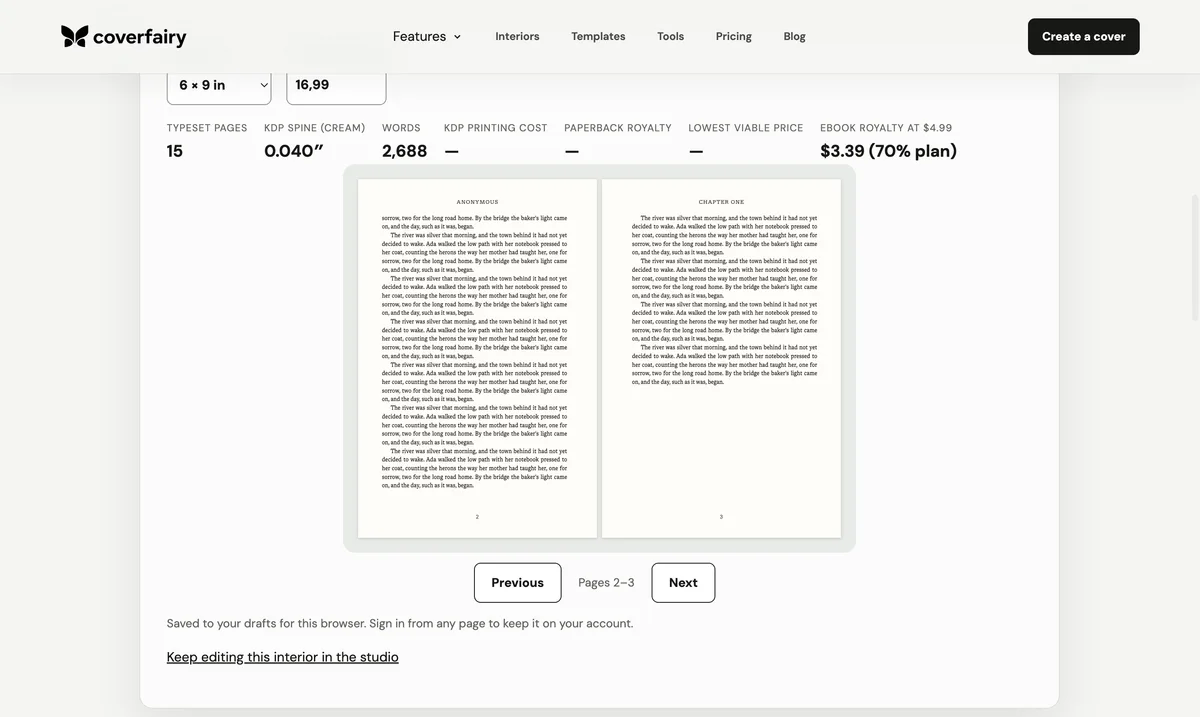
The file sent to the printer is the production object. Open that PDF in a separate viewer and confirm its page box, total pages, reading order, and first and last pages. Scan thumbnails for unexpected blanks, jumps, rotated pages, repeated pages, or a chapter that begins on the wrong side. Do not assume a successful export preserved the document setup.
Keep a record of the selected printer, trim, binding, ink, paper, bleed setting, and export date alongside the candidate file. A PDF can be internally consistent and still be wrong for the order if the upload form names a different trim or the cover was calculated from an earlier page count.
Verify trim, bleed, and safe content
A no-bleed page should report the final trim dimensions. A bleed page needs the enlarged dimensions and artwork extended beyond the cut at every edge where it is intended to print. Text, folios, captions, and essential image content must remain inside the printer's safe area even when a background continues into the bleed.
Do not add reader spreads, printer pairs, crop marks, or extra canvas unless the provider explicitly requires them. Print-on-demand interiors commonly expect individual pages in normal reading order. Scaling a Letter or A4 PDF at upload is not a reliable route to a smaller book because it changes the type, margins, images, and pagination together.
Check fonts, text, and hidden material
Inspect the PDF font properties and confirm every typeface is embedded or embedded as an allowed subset. Missing fonts can substitute, reflow, or change line breaks at production. Confirm the license permits embedding and commercial print use, and test accented letters, punctuation, symbols, small caps, and bold or italic variants used in the real book.
Search for comments, annotations, form fields, links that print visibly, hidden text, placeholder copy, proof watermarks, registration elements, crop marks, and document security. Encryption or restrictions can stop processing. Select and copy sample text to catch pages accidentally flattened to low-quality images when live text was expected.
Inspect images, lines, transparency, and color
Judge image resolution at the final placed size rather than from the original pixel dimensions. KDP currently specifies at least 300 DPI for interior images and warns that excessively large files can also delay processing. Inspect grayscale conversion, rich backgrounds, thin rules, charts, captions, transparency, and any object that sits close to the edge.
Zooming far into a screen preview cannot predict paper, ink spread, banding, or show-through. Use preflight software to flag fonts, transparency, image resolution, color, and PDF compatibility, then inspect the actual pages those warnings identify. Automated checks find technical conditions; they cannot decide whether a photograph is too dark or a table is readable.
Reconcile pagination with the book and cover
Compare the PDF's visible folios with its file-page sequence and the contents, index, notes, and cross-references. Check that intentional blanks are truly blank and that ordinary blank pages are not caused by a stray paragraph or section break. Review every chapter opener, running head transition, full-page image, appendix, and final page.
Use the final accepted interior page count to calculate the print spine. If any correction changes pagination, regenerate the PDF, recalculate the wrap, and preflight both again. Name versions clearly so an older cover cannot be paired with a newer interior during upload.
Finish with platform preview and a physical proof
Upload the candidate PDF, select the matching production options, and investigate every preview warning. If a platform proposes an automatic repair, understand what it changes and prefer fixing the source. Save the exact file that passed so later corrections start from a traceable version rather than an unknown desktop export.
Order a physical proof and read representative pages in normal light. Evaluate body scale, line spacing, gutter comfort, paper, image reproduction, margins, binding, cover alignment, and the relationship between recto and verso pages. Record corrections in the source document, regenerate all affected files, and repeat the final checks.
Sources: Amazon KDP: Paperback submission guidelines · Amazon KDP: Convert a paperback Word file to PDF · Amazon KDP: Trim size, bleed, and margins · Adobe Acrobat: Analyze documents with Preflight. Reviewed ; recheck current platform requirements before production.